Wan 2.2 A14B
Wan 2.2 A14B creates a video from a text prompt. With only Prompt supplied, it starts from noise; add a Reference image to guide the first frame.
Studio uses the text-to-video and image-to-video A14B models from the official Wan 2.2 release.
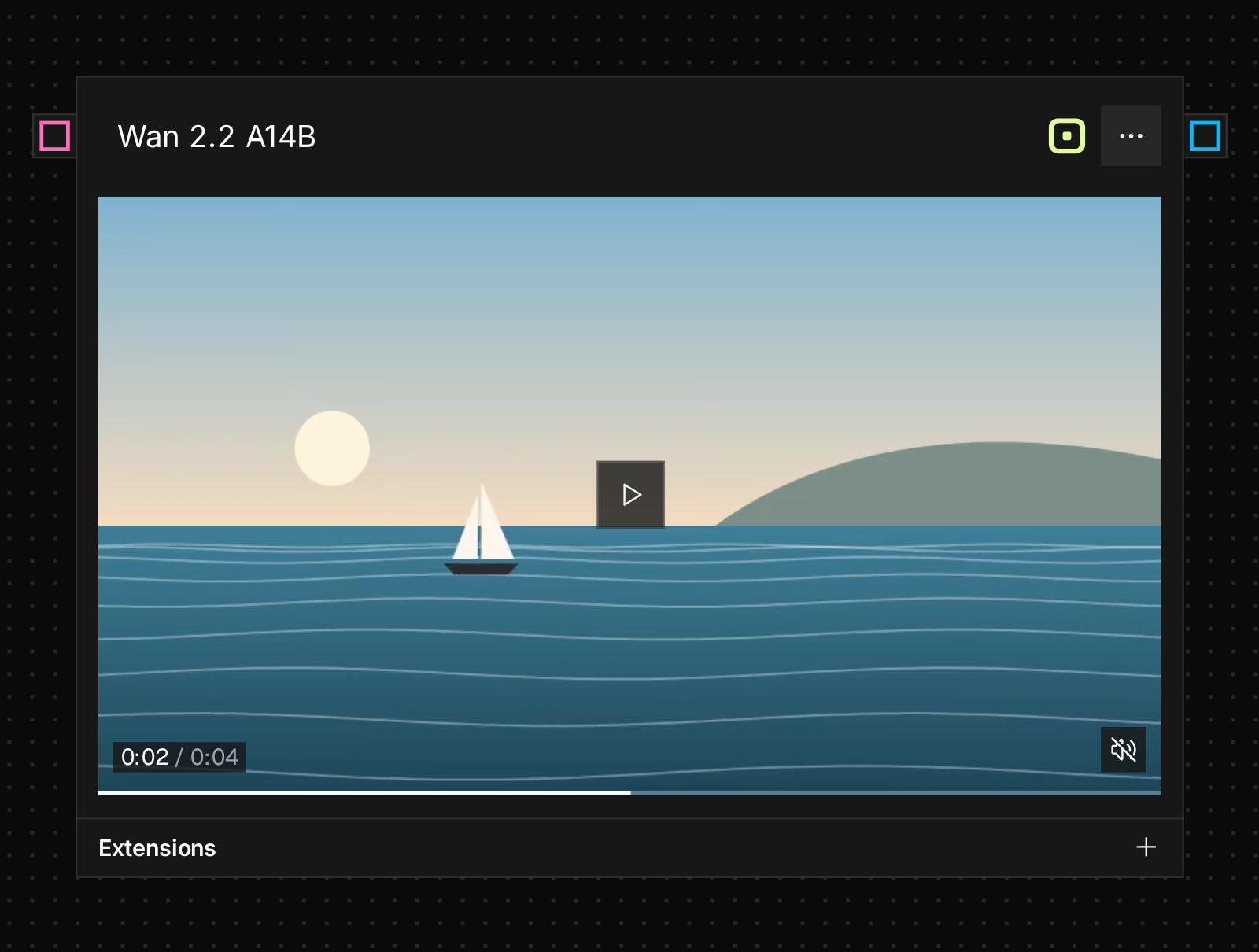
The video is illustrative placeholder media, not a checked generation result.
Generate a clip
- Add Wan 2.2 A14B to your Graph.
- Connect Text Input to Prompt and describe the subject, action, and scene.
- Choose the dimensions and Frame Count in the Node's settings.
- Run the Node and inspect its Video output.
The output is an RGB video at 16 frames per second, without sound. For example, 81 frames play for about 5.06 seconds. Use Set Video Audio to add a soundtrack.
Start from an image
Add the Reference Model Extension, then connect an Image output to Reference. Describe the motion you want in Prompt.
Without a connected latent, the reference determines the dimensions. Studio rounds each side up to a multiple of 16 and extends the image's edge pixels to fill the extra space. The resulting video uses that aligned size.
Connecting a reference also resets Shift, CFG (High Noise), and CFG (Low Noise) to the image-to-video settings. Check these controls after making the connection if you previously customized them.
Adjust guidance and sampling
Add Guidance to expose Negative Prompt and the two CFG controls. A negative prompt describes things to avoid. Supplying one replaces the model's built-in negative prompt; an empty String replaces it with no text.
Wan 2.2 uses separate high-noise and low-noise models during generation. Studio switches between them automatically. CFG (High Noise) and CFG (Low Noise) control text guidance for those respective stages; both must be finite numbers.
| Setting | Meaning and requirement |
|---|---|
| Inference Steps | Number of sampling steps. Must be a positive whole number. |
| Sampler | Choose Euler or UniPC. |
| Shift | Changes the sampling schedule. Must be finite and greater than zero. |
| Seed | Use a fixed seed to keep the random starting point, or random mode for a new one when the Node executes. |
The ranges shown by numeric controls are not additional model limits. Check the dimensions and processing limits below when a Run is rejected.
Use latent data
Add Latent I/O to expose a Tensor input and output. The input accepts normalized Float32 Wan latents shaped [16, T, H, W], with positive axis sizes. See Wan compression and latent convention for what the axes represent and how normalization works.
A connected latent determines the dimensions and frame count, so the corresponding settings are disabled. Studio extends odd latent width or height to the next even size. You can also connect a Reference: Studio scales that image to fit the latent's canvas, centers it, and extends edge pixels into any remaining space.
Use Wan VAE Encode to prepare a latent from video. The Latent output contains the generated representation before video cropping; connect it to Wan 2 VAE Decode to view it as video at a chosen frame rate. The Wan2.1 latent format used by this Node does not include a soundtrack.
Dimensions and limits
| Input or output | Limit |
|---|---|
| Prompt and Negative Prompt | Each is tokenized to at most 512 tokens; text beyond that limit is truncated. Tokens are not the same as characters. |
| Frame Count | A positive whole number of the form 4n + 1, such as 81 or 85. A connected latent determines it instead. |
| Processed dimensions | At most 4,096 pixels per side and 4,194,304 pixels in total. |
| Combined dimensions and frames | At most 302,400 sequence tokens, calculated below. |
Processing rounds width and height up to multiples of 16. When dimensions come from the settings, Studio crops the finished video back to the requested size. Reference and latent inputs produce the aligned size instead.
The combined budget is:
ceil(width / 16) × ceil(height / 16) × (1 + (frames − 1) / 4) ≤ 302400
Here, ceil means round up to the next whole number. Increasing duration leaves less room for resolution, and increasing resolution leaves less room for duration. The general Video limits also apply.
Give a coastal clip a soundtrack
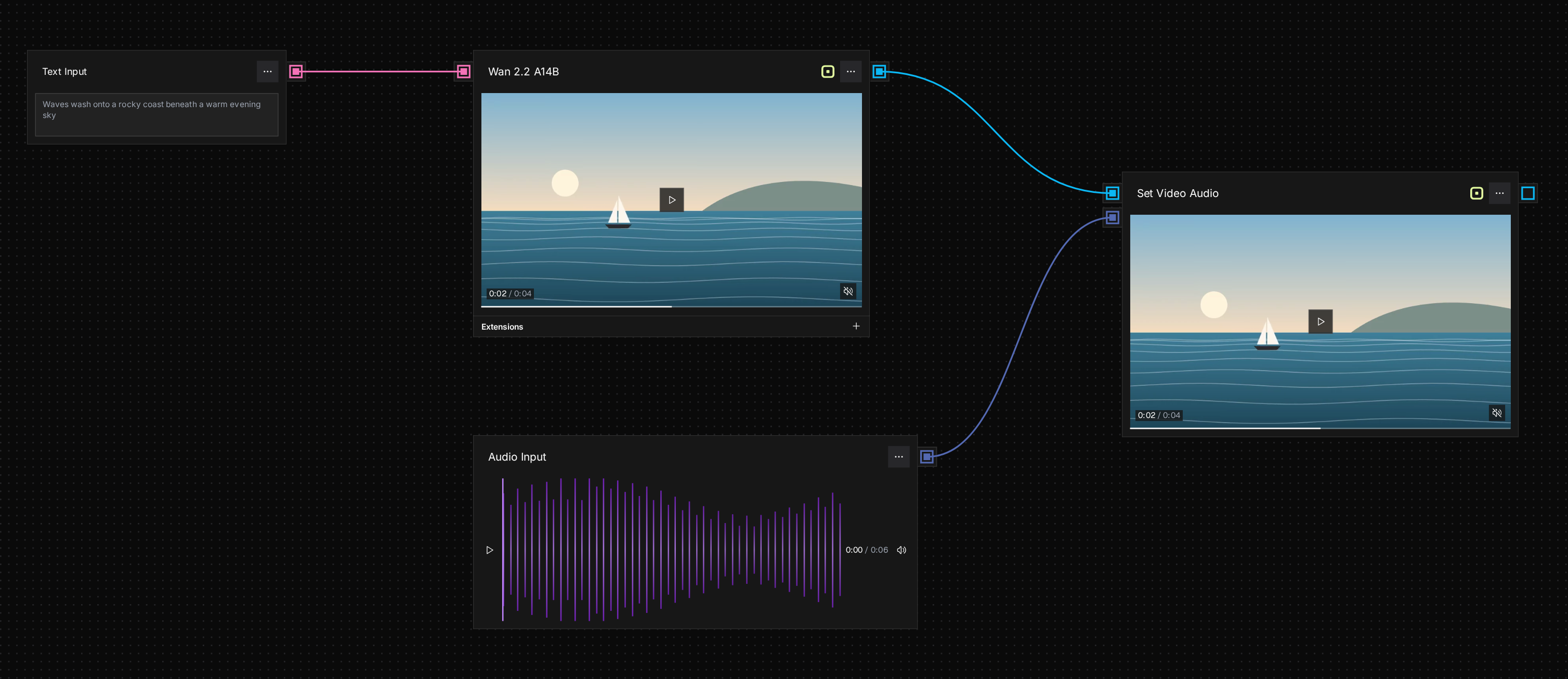
Wan 2.2 A14B used to create a coastal clip with a musical soundtrack; all media and generated results are illustrative.